
England’s Sustainable Farming Incentive aims to compensate farmers for environmental public goods. However, as farmers prepare to apply within a limited window with no fixed closing date, a challenging question emerges: should access to long-term environmental funding be based on who submits first?
Farmers preparing for the second Sustainable Farming Incentive 2026 application window are getting a clear reminder: prepare yourself.
Verify the Single Business Identifier and examine each parcel on the Rural Payments Agency map. Address any discrepancies between the digital records and the actual on-site situation. Determine the appropriate actions for the farm, gathering evidence of management control or tenancy rights. Avoid committing more land than the farm can sustainably manage. Most importantly, be ready to apply when the application window opens.
This advice is understandable on one level. Public schemes require precise information, and farmers need to understand their commitments. An environmental agreement that seems beneficial in theory can turn into a liability if it clashes with cropping, grazing, a tenancy, or the challenges of a tough season.
However, a broader question underlies the administrative guidance: how does England finance environmental recovery?
Window 2 of SFI26 is scheduled to open on 22 September 2026 for all eligible farmers and land managers, with no specified closing date. According to Defra’s regulations, the closure will depend on demand, and updates will be issued once 25%, 50%, and 75% of the funding has been allocated. After an extra £50 million was announced due to drought conditions, Defra now states that the total SFI26 budget for the year is £290 million. Any unspent funds from Window 1 will roll over into Window 2.
The scheme could stay open for a while, but it might also close sooner. Applicants understand that the budget is limited, so the best approach is to start preparing early.
This creates a peculiar tension. SFI is part of a nationwide effort to restore soils, safeguard water, create habitats, decrease agricultural pollution, and enhance farming resilience. These goals are long-term public ambitions. However, the scheme is managed through controlled enrollment periods and limited funding, which could mean eligibility partly depends on administrative speed.
If farmers are expected to provide benefits for society at large, should the chance to do so be competitive like a race?

From agricultural subsidy to “public money for public goods”
Understanding SFI requires recognising the post-Brexit shift in English agricultural policy. Previously, under the EU’s Common Agricultural Policy, farm support was mainly through direct payments linked to land area. Critics argued this approach favoured large landholders and neglected environmental outcomes.
The Agriculture Act 2020 established a new legal framework in England, empowering the Secretary of State to fund goals such as environmental protection, public access, climate change adaptation, heritage conservation, and soil and plant health.
This policy emphasises “public money for public goods,” rewarding actions that benefit society but may not be reflected in market prices, such as farmers improving soil health.
Public payments aim to bridge this gap. SFI is part of the broader Environmental Land Management program, designed to integrate environmental practices into working farms. Legally, Section 1 grants the Secretary of State the authority to allocate funding and set conditions, not a guaranteed right for farmers to receive payments. This distinction is central to SFI’s framework.
Eligibility is not entitlement
A farmer might meet the published eligibility criteria but still lack a legally enforceable right to an SFI agreement.
Eligibility indicates that a person is allowed to apply for the scheme. However, it does not imply that Parliament has mandated the government to fund all eligible applications regardless of the budget. Until an agreement is made and accepted, an applicant is usually requesting the exercise of a discretionary public power rather than asserting a right granted directly by law.
Once an SFI agreement is in place, the position changes. The agreement’s terms and conditions govern the parties’ rights and obligations. The farmer becomes entitled to payment on compliance, while the Rural Payments Agency may monitor delivery, vary matters where the terms permit, or recover money following a breach. However, the legal security attached to an existing agreement is not the same as a prospective applicant’s hope of receiving one.
That does not give Defra unlimited freedom.
The Agriculture Act mandates the creation of multi-year financial assistance plans that outline the government’s strategic priorities and how it intends to use its financial assistance powers. When determining the assistance to offer and setting the overall budget for a scheme, the Secretary of State must consider the priorities specified in the relevant plan. Additionally, the Act permits attaching conditions, as well as monitoring and enforcement arrangements, to public funding.
More broadly, Defra and the RPA are public bodies. Their decisions remain subject to public law. They must act within the powers Parliament has granted, consider relevant factors, avoid irrational distinctions, follow legally required procedures, and apply published criteria fairly. Clear promises or established practices can sometimes create a legitimate expectation that a particular process will be followed.
Judicial review is therefore possible, but its role should not be exaggerated. A court does not normally decide how much money ought to be allocated to SFI or substitute its preferred agricultural policy for that of ministers. It examines the legality of the decision-making process. Even a successful challenge may require the decision to be taken again, not an order guaranteeing every claimant a funded agreement.
This distinction matters for public debate. A system can be lawful while still being badly designed. Equally, ministers’ wide discretion does not mean fairness, consistency, and reliance on official information are optional.
The warning from the 2025 closure
SFI has already demonstrated a practical example of how administrative promises hold legal significance.
In March 2025, Defra suddenly ceased accepting new applications for the existing SFI offer after the budget was fully allocated. This abrupt closure sparked immediate anger, not only due to the loss of access but also because some farmers had seen wording on the government system suggesting that notice would be provided before applications closed.
The National Farmers’ Union filed a legal complaint, prompting the government to revisit its decision. As a result, it agreed that approximately 3,000 affected farmers should have another chance to apply. However, ministers did not admit that SFI was an unlimited entitlement. The core issue centred on whether it was fair and lawful to close access when applicants had been provided with information they could reasonably rely on.
This episode demonstrates the doctrine of legitimate expectation within a notably concrete agricultural context. Generally, a clear and unequivocal assurance from a public authority can create an expectation that it will follow a specified procedure. The enforceability of this expectation depends on the precise language used, the specific circumstances, the claimant’s reliance, and whether public interests outweigh the expectation. Merely hoping a scheme remains accessible is insufficient for establishing a legal expectation.
But public bodies cannot treat their own published assurances as meaningless.
SFI26 seems to be partly a response to that prior experience. Defra now clearly states that it cannot set a fixed closing date, as closure depends on demand. The department plans to publish updates on funding allocations and has conducted two application windows. The first window focused on smaller farms and those without an existing ELM revenue agreement, attracting approximately 6,500 applications. Additionally, Defra kept most applications started but not submitted by the end of Window 1, though it clarified this would not set a precedent for Window 2 or later schemes.
These efforts aim to clarify and control access, yet they don’t fully resolve the core policy issue. Informing applicants beforehand that funds could be exhausted improves transparency, but it doesn’t guarantee fairness in how the funds are distributed.

Is “first ready” the same as “most deserving”?
Administrative readiness is not evenly distributed across farming.
A large estate or a well-capitalised business might hire a land agent, farm secretary, or environmental adviser. Its digital maps could already be managed by experts. The organisation might also have staff ready to track announcements and submit applications as soon as the system opens.
A small family farm might rely on a single person to handle livestock, machinery, paperwork, and household chores. Tenants could require landlord approval or proof. An older farmer might be less familiar with digital tools. Farms recovering from drought, disease, or loss often face urgent challenges that take priority. Correcting mapping errors can be time-consuming, even if the applicant is not at fault.
None of these differences tells us which holding could deliver the greatest environmental benefit.
When funding is distributed based on the order of completed, eligible applications, administrative capacity inadvertently acts as an unsanctioned selection criterion. This can favour applicants already well integrated into government systems, while those who most need support to engage in the environmental transition may be unfairly disadvantaged.
The law does not establish a general right to equal treatment for farms of varying sizes. Farm size is not recognised as a protected characteristic under the Equality Act 2010. While the public sector equality duty could be relevant if policies have predictable effects related to protected characteristics, it does not ensure equal opportunities or outcomes for all businesses.
The stronger argument rests on rational scheme design and distributive fairness. If SFI’s purpose is to purchase environmental public goods and support sustainable food production, allocation should align as closely as possible with those objectives. Speed may be administratively convenient, but convenience is not an environmental outcome.
Window 1’s focus on smaller and previously unsupported farms indicates that Defra acknowledges this issue. A phased approach can be intentionally employed to broaden access. The concern is whether this principle will remain once all eligible applicants join the same Window 2 queue.
Tenants, management control and the ownership problem
The requirement to demonstrate sufficient management control is understandable. Public money should not fund actions that an applicant has no legal authority to carry out for the duration of the agreement.
But this requirement exposes a deeper issue in English land policy. The person farming the land, the person owning it and the person entitled to make long-term decisions about it may not be the same person.
Tenant farmers may be particularly constrained. An SFI action that suits the holding ecologically may conflict with the tenancy, require landlord consent, or affect future rent negotiations. Short or insecure agreements can make multi-year environmental management difficult. Where landlords wish to reserve land for development, biodiversity net gain, carbon projects, or another private environmental market, the tenant’s choices may narrow further.
The Farmers Weekly article advises applicants to look beyond the three-year agreement and retain flexibility for future biodiversity, carbon, water or nutrient markets. That is commercially sensible. It also highlights an emerging contest over environmental value.
A field may be imagined simultaneously as productive land, habitat, a carbon store, a nutrient-mitigation site, a development opportunity and a source of public subsidy. The person with legal control of the land largely chooses among those futures. Where ownership and farming are separated, the party carrying out daily stewardship may not capture the long-term value created.
SFI cannot solve land-tenure inequality on its own, but its design can either soften or reinforce it. Clear rules for tenants, proportionate evidence requirements, compatibility with different tenancy models, and protection against the unfair appropriation of publicly funded environmental improvements should be central, not peripheral, concerns.
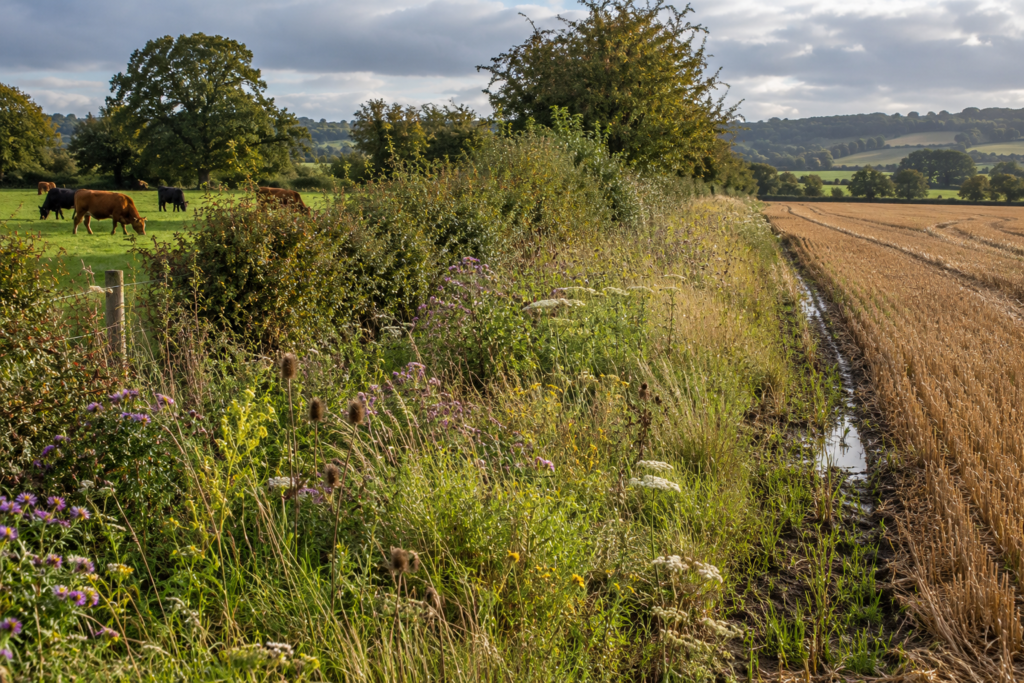
Paying for actions or supporting agroecological transition?
From an agroecological perspective, SFI contains real opportunities.
Payments for soil assessment and management, integrated pest management, low-input grassland, hedgerows, diverse vegetation, and reduced reliance on artificial inputs can support important ecological processes. They can make practices financially viable where commodity markets fail to reward them. They can also give farmers permission to experiment without bearing the full cost of transition.
Yet a menu of funded actions is not agroecology.
Agroecology asks how the whole farm functions as an ecological and social system. It examines relationships among soil, crops, livestock, water, wildlife, labour, knowledge, markets and the surrounding community. A scheme divided into individual actions can encourage improvement, but it can also fragment the landscape into claimable units.
This creates several risks.
First, applicants are understandably encouraged to select “high-value” actions that already fit their system and have low implementation costs. That may deliver good value where existing practice is already beneficial. But it can also reward what is easiest to claim rather than the change most needed for ecological reasons.
Second, short agreements may encourage short planning horizons. Soil restoration, agroforestry, species recovery and changes in farm structure often take much longer than three years. Farmers need confidence that policy will endure beyond the current window and Parliament.
Third, “stacking” SFI with private natural-capital markets may generate additional income, but it also raises legal and ethical questions. Who owns an environmental improvement funded in part by taxpayers? Can the same action also generate a private carbon or biodiversity credit? Are the claimed benefits genuinely additional, or is the public paying first so that private value can later be extracted? SFI rules address compatibility and double funding, but the rapid growth of environmental markets will continue to test those boundaries.
Finally, action-based payment can leave the underlying food system untouched. A farmer may improve soil or establish habitat while remaining squeezed by processors, retailers, input costs and insecure tenancies. An agroecological transition requires fair markets and viable farm businesses, as well as environmental management. Public money cannot purchase lasting public goods from farms that are not economically viable.
Food production is not legally absent
Criticism of environmental schemes sometimes assumes that the Agriculture Act has forgotten about food production. That is not quite right.
The Act requires the Secretary of State, when framing financial-assistance schemes, to have regard to the need to encourage environmentally sustainable food production in England. It also contains wider provisions on food security and agricultural markets.
SFI26 itself states that sustainable land-management actions should benefit the environment while supporting food production and productivity. Its £100,000 annual agreement-value cap and restrictions on certain “limited area” actions are partly intended to control concentration and prevent excessive areas from being removed from production.
The harder question is how the balance is made in practice.
Food production and environmental recovery should not be treated as competing claims over every hectare. Productive agriculture depends on functioning soils, water, pollinators and a stable climate. But genuine trade-offs exist. Habitat creation can affect output. Reduced inputs can entail transition risk. Land committed to one environmental market may become unavailable for food or another public purpose.
A credible scheme should therefore reward farms for integrating production and ecology rather than inviting them to assemble whichever isolated options yield the best short-term return. This requires advice, monitoring and landscape-level coordination—not merely an online application portal.
Could the current system be made fairer?
No single approach is perfect for allocating a finite environmental budget. A fully competitive system based on detailed scoring could be slow, expensive and dominated by professional grant writers. A lottery would be simple but poorly linked to ecological outcomes. An entirely open-ended entitlement would give farmers certainty but leave government unable to control expenditure.
The answer is not necessarily to abandon application windows. It is to design them so that urgency does not become the hidden organising principle.
Several reforms could help.
1. Publish the allocation method in plain language
Applicants should know whether eligible applications are treated in order of submission, assessed in batches, prioritised by category or ranked against environmental criteria. “Controlled rollout” is not a substitute for explaining how scarcity will be managed.
2. Retain staged access
Separate periods could be reserved for smaller farms, tenants, new entrants and holdings without existing environmental agreements. Window 1 demonstrates that prioritisation is administratively possible.
3. Provide a minimum application period
Subject to exceptional demand, government could guarantee that a window will remain open for a stated minimum period. If applications exceed the budget during that period, allocation could then use published priorities rather than the exact submission time.
4. Separate registration from final application
A short expression-of-interest stage could identify demand without requiring every map and action to be finalised immediately. This would give Defra better budget information and reduce the incentive to rush digitally.
5. Fund independent advice
Access to public environmental money should not depend on being able to purchase private consultancy. Properly funded, locally available advice could help farmers choose actions that fit their ecological and business circumstances.
6. Improve mapping and digital accountability
Applicants should not lose access because official records cannot be corrected in time. There should be clear escalation routes, auditable decisions and protection for those who notified the RPA of an error before closure.
7. Offer longer-term policy certainty
Defra has said it intends to stabilise SFI’s main design during the present Parliament and offer SFI27. That is welcome, but ecological transition requires confidence extending beyond individual three-year agreements. Multi-annual plans should contain enough budgetary and operational detail to guide real farm investment.
8. Report who receives the money
Transparency should cover not only how quickly the budget is allocated, but also how it is distributed by farm size, tenure, region, and action type. Without that information, it is difficult to know whether “public money for public goods” is reaching a broad farming population or concentrating among those already best equipped to apply.
9. Measure outcomes as well as uptake
The number and value of agreements matter, but they do not establish whether soils, water, biodiversity or resilience are improving. Monitoring should be proportionate for farmers while still allowing the public to assess what its money has purchased.
A lawful scheme is not necessarily a just transition
SFI26 sits within a lawful framework created by Parliament. The Agriculture Act gives ministers wide power to decide what to fund, under what conditions and within what budget. Nothing in the Act requires an unlimited pot or guarantees every eligible farmer an agreement.
That may answer the narrow question of legal entitlement. It does not settle the wider question of legitimacy.
The state is asking farmers to help meet national environmental and climate objectives. It is asking them to manage soil, water, hedgerows and habitat not only as private assets, but as parts of a shared ecological system. In return, farmers are being told that public support is finite, conditional, and potentially time-sensitive.
Some scarcity is unavoidable. Public budgets always involve choices. But the method used to manage scarcity expresses a set of values. A first-ready system values speed and administrative completeness. A prioritised system may value inclusion, environmental need or additional benefit. A long-term entitlement would value certainty but carry a larger fiscal commitment.
Those choices should be openly debated, not concealed behind the apparent neutrality of an application portal.
The most telling detail in the current advice is that applicants should examine their digital maps with the same care they give a cropping plan. That may be necessary. Yet if environmental recovery depends on farmers becoming expert navigators of government systems, something has gone wrong in the relationship between policy and land.
The success of SFI should not be measured by how rapidly a funding window fills. It should be measured by whether it enables a wide and diverse farming population to care for land over time, while continuing to produce food and sustain rural livelihoods.
Public money for public goods was never meant to mean public money for the quickest applicants.
If nature’s recovery is a national priority, access to the work of delivering it must be designed with the same care as the actions themselves.